Rating: 3/10
Overall Thoughts
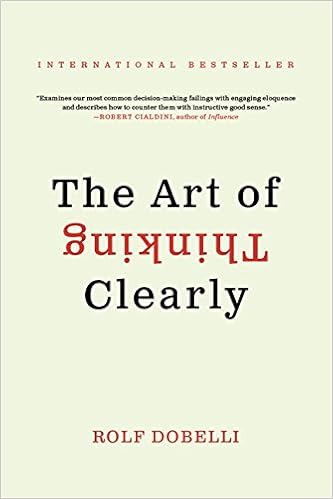
The Art of Thinking Clearly? International bestseller? I don't think so. Alas, I fell victim to the phrase 'never judge a book by its cover'; clearly the seemingly attractive front cover gave this book an aura of credibility it does not deserve. The title itself is misleading since this is not a self-help book containing advise on 'clear thinking'.
This book consists of 99 short chapters which mainly discusses psychological findings of other individuals/sources and comprises of illustrations which are primarily related to the medical or investment/business industry, which is clearly not relatable to most people, myself included. Further, 3 pages per chapter is barely sufficient to critically discuss a concept/subject. This book lacks central argument, and is essentially a list of cognitive biases with bare descriptions.
Instead of helping me shape my thinking and decision-making process, this book has done the exact opposite. Truth be told, I did not take away any useful information/tips from this book. It was a definite struggle to actually finish the entire book.
Summary of 'The Art of Thinking Clearly'
- In daily life, because triumph is made more visible than failure, people systematically overestimate their chances of succeeding. Guard against it by frequently visiting the graves of once promising projects, investments and careers.
- Rational decision making requires you to forget about the costs incurred to date. No matter how much you have already invested, only your assessment of the future costs and benefits counts.
- Whenever you hear a story, ask yourself: Who is the sender, what are his intentions, and what did he hide under the rug? The real issue with stories: They give us a false sense of understanding, which inevitably leads us to take bigger risks and urges us to take a stroll on thin ice.
- Do you have everything under control? Probably less than you think. Focus on the few things of importance that you can really influence. For everything else: Que sera, sera.
- If you want to convince someone about something, don't focus on the advantages; instead highlight how it helps them dodge the disadvantages.
- Forget trying to amass all the data. Do your best to get by with the bare facts. It will help you make better decisions. Superfluous knowledge is worthless, whether you know it or not.
- Raise expectations for yourself and for the people you love. This increases motivation. At the same time, lower expectations for things you cannot control.
- We make complex decisions by consulting our feelings, not our thoughts. Against our best intentions, we substitute the question. "What do I think about this?" with "How do I feel about this?"
- First and last impressions dominate, meaning the content sandwiched between has only a weak influence. Try to avoid evaluations based on first impressions. Try to assess all aspects impartially.
- When do you listen to your head and when do you heed your gut? A rule of thumb might be: If it is something to do with practical activities, such as motor skills or questions you've answered a thousand times, it's better not to reflect to the last detail. It undermines your intuitive ability to solve problems.

No comments:
Post a Comment